
Emergency and Storm Tree Removal in Lawrence, KS
Lawrence Tree HQ takes down storm-broken wood in Lawrence, KS, from an ice-loaded elm split over a carport to a hackberry the wind laid across a driveway. Before any saw starts, we look at what each piece presses on and which way it shifts once a cut frees it. Calls also come in from Eudora, Baldwin City, De Soto and Tonganoxie.
Request a quote
Say where the tree stands and what worries you about it. A call back follows with a first range.
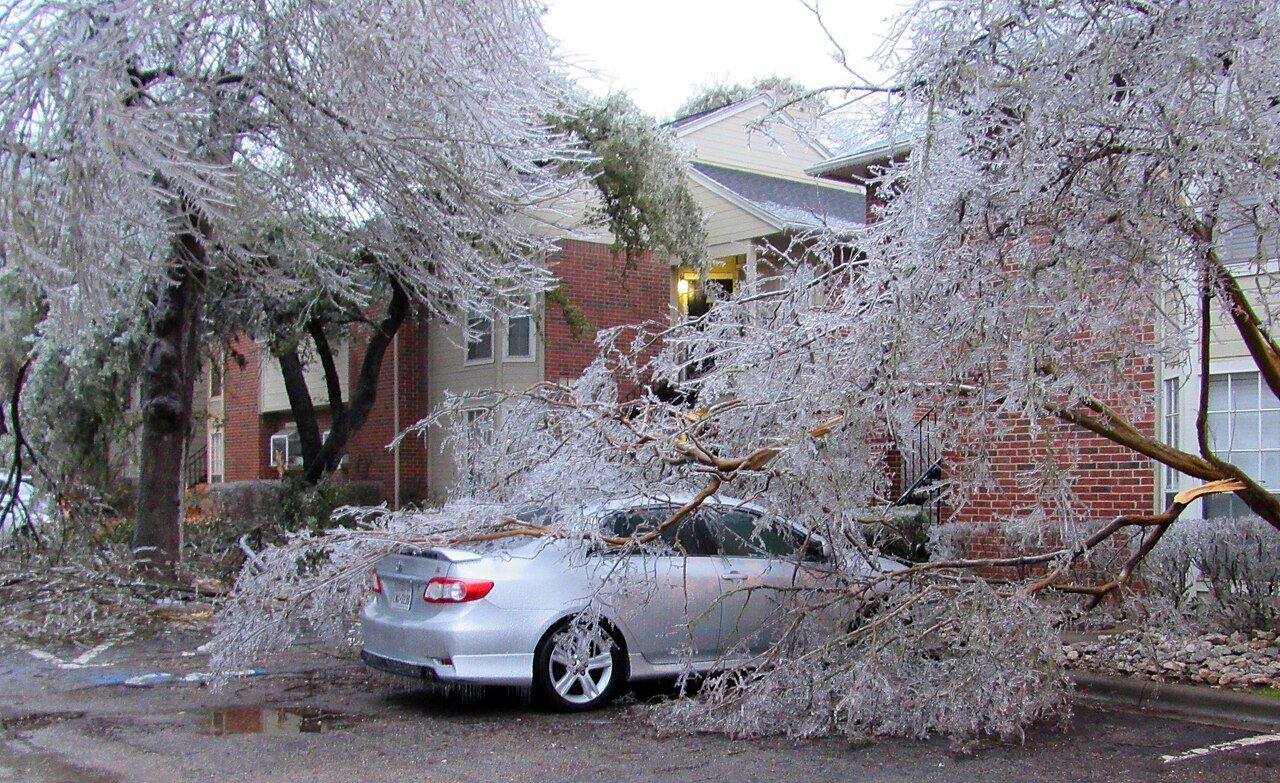
We recommend that any time a tree has fallen, the homeowner tell us exactly what the tree is lying on. If the tree is on the shingles of your roof or on a wire, then the tree service should get to you first, before anyone else.
- Damage photographed before a single piece moves
- Service drops left to Evergy until confirmed dead
- Tension in bent limbs read before each cut
- Weight lifted off shingles in small sections
- Brush ground up and trucked away, never left curbside
Base rate
Typical prices per tree for Lawrence jobs. Your quote follows a look at the job.
$360 to $690
Call (785) 538-3193 for your priceAt a glance
| Base for a 30 ft tree | $360 to $690 booked |
|---|---|
| Base for a 50 ft tree | $600 to $1,160 booked |
| Rush multiple | Twice to three times base, same or next day |
| After dark | $150 to $250 per crew hour |
| Crane in the street | Right-of-way permit from $50; the sidewalk is closed |
| Grinding afterwards | Kansas 811 notice 2 full working days ahead |
Storm Tree Removal Services
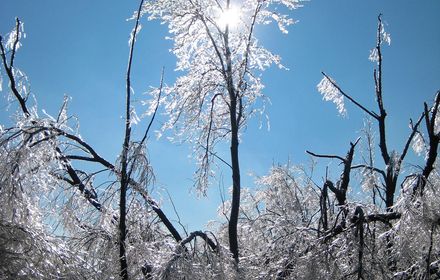
Ice-Loaded Limbs and Split Crowns
Ice adds weight to every twig at once. Limbs and whole trunks give way under that load. That January 2002 storm put 1 to 4 inches of ice on eastern Kansas and left more than 10,000 customers across Lawrence, Baldwin and Ottawa in the dark. A split crown usually means the standing half goes too, since its open wound runs down into the stem.
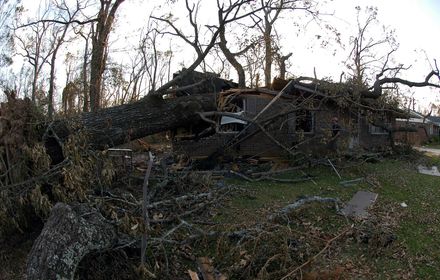
Trunks Through Shingles or a Carport
Rafters it broke now hold part of its weight. Cut at a bad spot and that load drops onto the ceiling below. Crews tie off the top, shorten the crown a few feet at a time and lift the stem away piece by piece, by rope, or with a crane once a log gets too heavy to swing. A tarp covers the hole before anyone drives off.
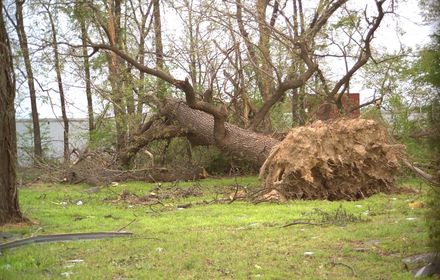
Wind-Thrown Trees With Roots Up
Soaked spring soil lets a full canopy lever its whole root plate up. On March 12, 2006, a microburst drove 70 to 90 mph winds across Lawrence and laid trees down this way. A plate standing on edge can drop back into its pit once a saw frees the stem, so that end gets chained or braced first.
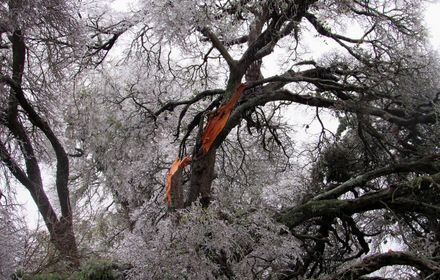
Hung Limbs and Broken Tops
A snapped limb wedged in upper branches can stay put for days, then drop on a still afternoon. Ours get roped from above and lowered, never cut loose to fall. Where a top broke away from an old oak, our climber checks that break for rot already there before any wind found it.
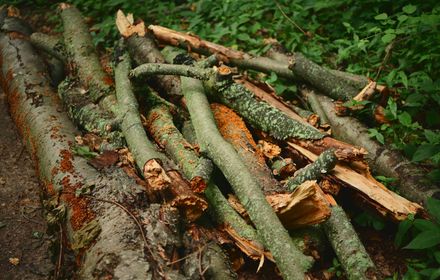
Storm Brush Cleanup and Hauling
Curbside pickup in Lawrence is built for tied bundles of twigs, not trunks. And the compost facility's contractor drop-off says plainly it is no place for major storm debris. So every storm job gets priced with hauling built in, leaves to log rounds, and a raked lawn when our truck pulls away.
More Storm Calls
Limbs on a Service Line
Wood lying on any wire means phoning Evergy (888-471-5275) first. Saws stay in the truck. No crew member handles a limb touching a line before Evergy calls it dead, and everything else on that tree waits with it.
Trunks Blocking a Street or Alley
Public right of way follows city rules, and parks staff handle trees in it. Clearing a privately owned trunk off the roadway can need a city right-of-way permit, and we file it with the job.
Trees Short One Big Limb
Plenty come through a storm short one big limb. Most can stay. Its torn stub gets trimmed back to a healthy lateral, then deep watering carries it through those first dry weeks, since stressed wood draws borers and wilt.
What Counts as Emergency Tree Removal
A tree removal emergency would be where a tree has fallen on a house, a car or power lines. This is considered an emergency and should be taken care of immediately, with caution, by a tree trimming service that knows what it is doing. Any tree that is cracked and will fall before a booking should also be looked at, as this can be dangerous with people around, especially right after a storm has gone through the neighborhood. A tree that has fallen is not considered an emergency if it’s out in the open lawn and has not hit anything, or if it would not hit any kind of structure or hurt anyone if it were to fall.
How a Storm-Damaged Tree Comes Down
Photos first
Before a single piece moves, we photograph damage from the lawn and from the eaves, showing trunk, break and whatever got hit. Your insurer wants those pictures, and nobody can take them again once everything is cut up.
Wires and people clear
Under OSHA, nobody without line training works within 10 feet of an overhead line, counting any saw or pole in hand, so wood close to any line waits for Evergy. We tape off the drop zone and keep everyone uphill of a lifted root plate.
Read the loads
A bent limb pinned under its own weight is loaded like a drawn bow. Cut it on its tension side and it jumps or rolls. Each piece gets a landing spot picked before the saw touches it.
Unload the structure
Wood comes off a house in pieces small enough to control, tied off and lowered. A crane comes in when a log is too heavy to lift by rope.
Cover and secure
A tarp over any hole in the decking, plywood over a broken window. A leaning trunk that stayed up gets cabled back or felled during that same visit.
Chip and haul
Brush feeds our chipper, trunk wood gets cut to firewood lengths, and the stump is ground now or booked for later if you want it gone.
Take It Down or Let It Recover
One that dropped a limb or two but kept its main leaders usually pulls through. A stem split down its middle, a root plate lifted on one side, or a fresh lean toward your house all mean removal.
Emergency Tree Removal Cost in Lawrence
Emergency work is priced like any removal, plus speed. Removal done that day or the next commonly runs two or three times a standard rate. This table gives standard Lawrence ranges by height, so you can see what base an emergency rate starts from.
| Job | Typical range |
|---|---|
| Standard removal, tree about 30 ft | $360 to $690 |
| Standard removal, tree about 50 ft | $600 to $1,160 |
| Standard removal, tree about 70 ft | $840 to $1,620 |
| After-hours emergency crew time | $150 to $250 an hour |
Removal ranges are Lawrence, KS figures (2025); the after-hours rate is a national arborist range (2026). Neither includes stump grinding, roof repair or a crane.
Of two quotes, the more pricey one would most likely be more careful with your lawn, get rid of the stump and take away all the trash, so it’s up to you to decide if you want to save some money or would prefer to deal with it properly.
Cut It Now or Wait for Daylight
With a trunk on your house and rain coming, weight and hole cannot wait. With one down in the yard and lights out across town, a crew working by headlamp is slower and its rate is higher. In our view, holding off a day on that one is money saved.
If a big tree falls in your backyard at night and nothing is broken, we would wait for daylight and not worry about calling a tree service in the middle of the night. A 50-foot tree here can cost about $600 to $1,160 to be taken out, but at night that could cost two or three times as much.
Where an emergency bill lands depends on these parts:
- What got hit. Wood lying on shingles or a wire is priced above an upright trunk of equal size. One that fell cleanly into open lawn often costs less, since nobody has to climb it.
- How soon. Night and same-day work carries that emergency multiple. Next week costs normal rates.
- Crane or rope. A crane adds its own hourly charge, and saves hours of rigging over a house.
- Haul-away. Keeping the rounds for firewood takes trucking off the bill.
- Access. A back yard whose fence gate is too narrow for a loader means carrying every piece.
Kansas Storms and the Trees They Break
Lawrence averages 39.4 inches of precipitation a year and 10.4 inches of snow, but ice and straight-line wind are what break trees here. That December 2007 ice storm left only about a quarter inch of ice in Douglas County, and it still cut power to about 2,800 customers and swamped local tree companies. A thin coat on a full-crowned elm or hackberry is enough.
Wet ground is the other half. A spring storm after a week of rain finds roots sitting loose in saturated soil, with canopies fully leafed out and catching wind like a sail. That is when whole trees go over rather than limbs. A fresh lean after a storm, with soil cracked open on one side of its base, is worth a call before the next front comes through.
Emergency and Storm Tree Removal in nearby areas
Emergency and Storm Tree Removal FAQs
Does homeowners insurance cover removing a fallen tree from my house?
Yes, if a tree fell on your house or a garage or a fence, your homeowner policy should cover this. The usual payout from a homeowner policy can be around $500 to $1,000. Before anybody, yourself or any tree service contractor, touches the tree or any debris, and before any cleanup is done, be sure to take photos for insurance purposes.
My neighbor's tree fell into my yard in a storm. Who pays?
If the tree that fell into your yard from a neighbor's was a healthy tree, it's most likely your own policy that's going to cover this. If it was a dead tree that had been left standing for some time, then the neighbor is liable. Both insurance companies may need to be talked to before a lawyer is called.
A tree fell across the street in front of my house. Who clears it?
If a tree in front of your house was to fall and the tree is on city land, then the city is always responsible for the cleanup of this tree. If a tree on your property fell onto the road, then it is the owner's responsibility to remove the fallen tree or trees.
Will the city pick up the branches after a storm?
Yes, the city will pick up branches after a storm, but they have to be put into bundles. Bundles can be no longer than 5 feet and no more than 18 inches across. Be sure to never use wire when bundling, because this will not be allowed. It always has to be some type of string or twine that is used to tie the bundles together.
Can I cut up a fallen limb myself?
Any limbs that have fallen on the grass and are not touching anything that looks dangerous are fine for the homeowner to cut up. Any limbs that are bent and under tension should be treated cautiously, as they can snap up, hit the person who is sawing the limb and injure them.
How do I tell a real tree company from a storm chaser?
Any time after a storm, we recommend that any tree trimming service you are calling or looking to use has a city tree trimmer license. Also check that they have a minimum of $50,000 liability insurance and that the name on the trucks is at least three inches high. Storm chasers typically will not have a license and should be avoided.
Get a quote on your emergency and storm tree removal
Give the street, a rough height and whatever sits below the crown. The call back brings a range and the parts that could raise or lower it.
Request a quote
Ring (785) 538-3193 to talk it over now, or write the tree up here for a call back.